
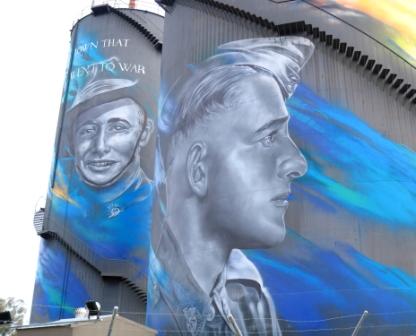
Painted silos and water towers have become popular tourist attractions in rural areas of Australia and these grand scale paintings are attracting travellers to regions to see their breathtaking beauty.
Many depict landscape and scenes of the local areas as well as wildlife, flora and historical references. Others depict local heroes which can spark a curiosity to delve deeper into the stories behind the faces.
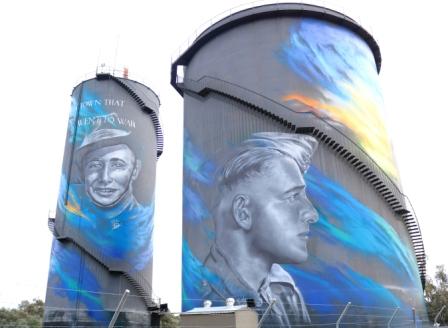
The water tower in the rural town of Hay in New South Wales made me do just that, and with Remembrance Day just around the corner, it’s a fitting time to share their stories.
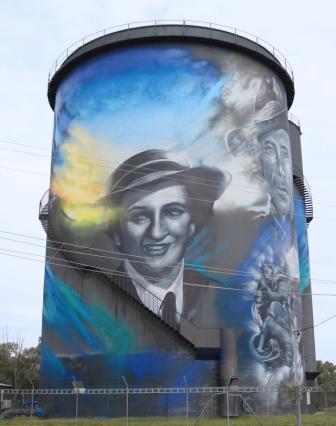
On the tower, the faces of young uniformed men and one woman stand out boldly, the pride on their faces palpable.
The woman is Lorna Margaret Whyte who was a Lieutenant in the Australian Army Nursing Service. Born in 1915, she joined up in 1941 and served at the Australian General Hospital in Rabaul in New Guinea, sadly becoming a prisoner of war in 1942 following the invasion by Japanese troops.
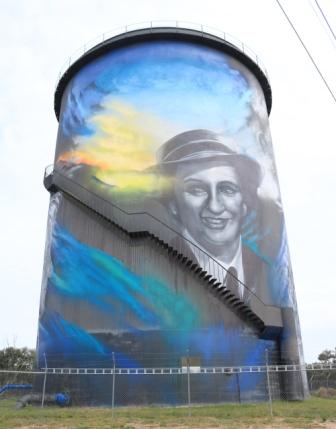
After three years as a POW in Japan, Lieutenant Whyte and other women were found by accident in August 19454 when General MacArthur’s troops marched into Tokyo. Her family in Hay, who had abandoned all thoughts of her safety, were advised she had been found alive and well and she returned to Australia in September 1945.
In 1948 whilst on a planned trip to America, she became ill and stopped in New Zealand to recover which took more than six months. While in New Zealand she met and married a local man who had served in the NZ army and lived out her life in New Zealand, before dying peacefully at the age of 89 in September 2013.
Her war story and that of other POW nurses in New Guinea, was made into a telemovie (Sisters of War) in 2010 and in 2011 she return to Japan at the age of 96 to receive an official apology from the Japanese government.
An indigenous man, Private Victor George Murray is also pictured. He signed up in 1940 but was discharged five months later as medically unfit. Undeterred he signed up again a year later and served in Singapore despite suffering acute and recurrent malaria. In 1943 he was honourably discharged from the Australian Military Forces for being medically unfit to serve.
After his discharge he returned to Hay and proudly attended Anzac Day marches, even when partly incapacitated by a stroke. He passed away in the Hay Hospital in 1976 aged 67 years.
Another face on the on the water tower is that of Private William ‘George’ Cannon who enlisted in 1939 and served in Egypt, Libya and Greece. His battalion suffered heavily in Crete and he became of prisoner of war but managed to escape and was shipped to Palestine where he joined a new regiment.
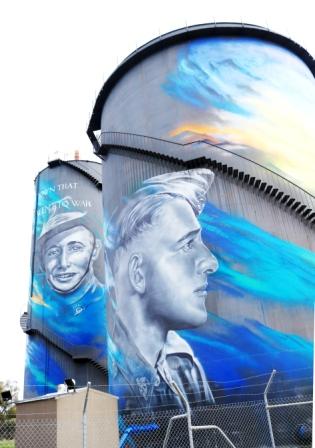
This regiment was recalled to Australia in 1942 in response to the growing threat of Japan and assigned to the defence of Port Moresby, in New Guinea. He was wounded in an air raid and honourably discharged after serving for five years. George and his wife retired to live in Hay and he passed away in September 2003.
Private Norman Charles Flack also appears on the tower and after his enlistment in 1940 he served in Malaya and eventually became another Japanese Prisoner of War. He was interred on the infamous Death Railway in Burma but managed to survive that hell only to be transferred to Japan to work for a number of years in a diamond coal mine.
He was only liberated after the bombing of Nagasaki and was transferred to a holding camp in the Philippines, before being returned to Australia and his work as a motor mechanic in Hay. He passed away in 1990.
Part of the painting shows a soldier clinging to a life raft. The soldier is Corporal Clifford Leslie Farlow, another local man who enlisted in 1940. He also served in Malaya and became a Prisoner of War at the surrender of Singapore. As with all of the POWs he was subjected to inhumane treatment at the hands of the Japanese Imperial Forces and was destined to be transferred to Japan to be used as slave labour.
Clifford however was being transported on the ship Rakuyo Maru which was torpedoed by a United States submarine and had to once again battle for survival by clinging to a makeshift raft, spending four days in the water. Miraculously, the few survivors were picked up by another US submarine and treated before being sent home to convalesce in Australia.
In 1945 Clifford received his discharge from the army after five years of service, most of which was in captivity. He lived and worked in Hay on his return, and died at the age of 84, on the 12th of September 2006, coincidentally at the exact time and date that his ship was torpedoed and sank 62 years earlier.
The artist who painted the water tower was Adnate who is a master at these type of large scale portraits, and many of his street artworks can be found around Australia.
The artwork and stories are a reminder to future generations of the courage and selflessness these young local men and women displayed.
Lest We Forget
Glenys
Discover more from Caravan Correspondent
Subscribe to get the latest posts sent to your email.
 Caravan Correspondent
We missed this one. There are so many beauties around the country now and we love finding a new one.
LikeLiked by 1 person
it’s hard to keep up with them, we found this just by chance when driving into Hay.
LikeLiked by 1 person
We drove through Hay but definitely didn’t go past it. Next time…
LikeLiked by 1 person