
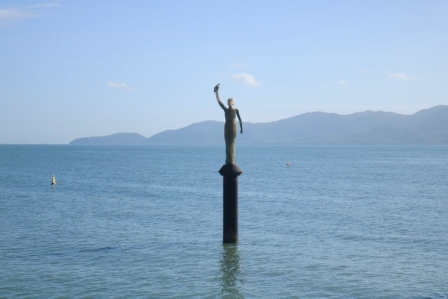
She stands as a sentinel in the water next to the Townsville jetty, a 4 metre high figure acting as a visual reminder of the importance to conserve our marine environments.
The striking looking sculpture was created by Jason Decaires Taylor, a sculptor, environmentalist and professional underwater photographer, and is modelled on Takoda Johnson, a young indigenous girl from the Wulgurukaba tribe.
In her hand she holds a Bayliss shell as she gazes out towards Magnetic Island and the Great Barrier Reef. At night the illuminated statue changes colour according to the average daily temperature of waters around the Great Barrier Reef.
The water temperature data comes from a live feed provided by the Australian Institute of Marine Science, which sends temperature readings from a weather station at Davies Reef on the Great Barrier Reef.
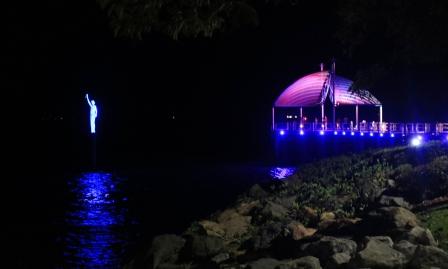
Ocean Siren has 202 multi coloured LED lights that illuminate at sunset and gradually change colour from the centre of the figure and outwards to the extremities, similar to a heat sensing camera image.
Temperature changes in the reef waters have been monitored since 1985 and the data shows an increase in heat stress on corals and a greater likelihood of bleaching events. Not every year experiences an increase in average temperatures, but with incidences occurring more frequently, it leaves less time for corals to recover from heat stress events.
This statue forms part of the Museum of Underwater Art which includes a series of art installations in the Townsville region and on the Great Barrier Reef, all of which also provide important scientific information on the effects of warming ocean temperatures on the local marine life
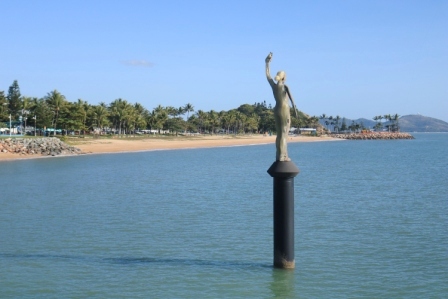
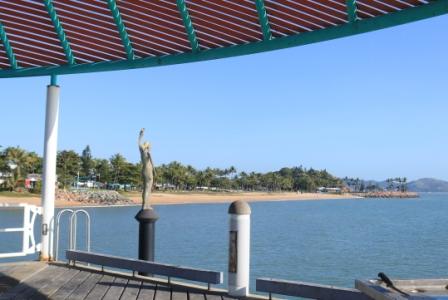
The Ocean Siren statue can be seen from various points along the coastline and up close from the jetty as it brings reef science directly to visitors, aiming to educate and encourage thinking about what the colours represent. It also provides globally important research on the effects of warming oceans on coral reefs.
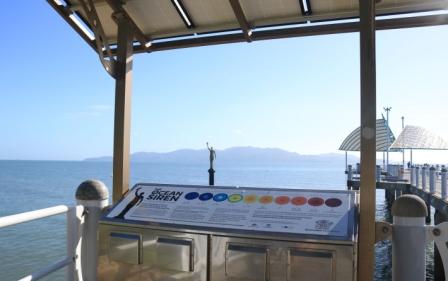
The average winter water temperatures for the area are usually 22-23 degrees Celsius and historically the summer maximum is 28.5 degrees. A warming of the ocean by just 1 -2 degrees Celsius above the usual summer maximum can result in temperature stress to tropical marine ecosystems. At 30 – 31 degrees coral bleaching is likely to happen and anything over 31 degrees, bleaching and coral death is probable.
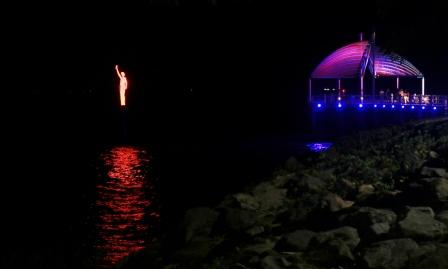
Ocean Siren can be found next to the jetty on The Strand in Townsville Queensland.
Cheers
Glenys
Discover more from Caravan Correspondent
Subscribe to get the latest posts sent to your email.
 Caravan Correspondent
Nice article. Love your work! Down here on the NSW coast, we are facing the dilemma of massive impacts on the marine environment by huge wind farms that proponents say will eventually help that same environment. With all the best long term intentions, it is hard to agree with short term disruption of such a staggering scale. People who don’t live near and love the ocean can’t understand our dilemma, but it is truly between a rock and a hard place.
LikeLiked by 1 person
Thank you, I’m sure it’s a difficult decision to make especially in the short term, but hopefully the bigger picture will see no harm done and long term gain. I’m not familiar with the project but we’ve had issues in SA that I definitely keep an eye on and try to learn about the impacts before weighing in.
LikeLike
She is a beauty, isn’t she.
LikeLiked by 1 person
Absolutely! It would be nice to see more ideas like this, with science and art coming together.
LikeLiked by 1 person